Dévorer
Designing a multi-sided payment, voucher and loyalty system for university street-food markets.
Dévorer on campus. Students ordering, vendors serving and teams running a live market. Everything below is about the system that makes these moments work at scale.
The product
Dévorer is a mobile-first loyalty and digital voucher platform. Universities fund student meals, students redeem them at campus street-food vendors, and every transaction feeds a loyalty layer that keeps students coming back.
Our role
We led the product design end to end, from defining the system's rules to production-ready flows, working with Dévorer's founders, university partners and vendors to shape both the product and its rollout.
Scope
A trust problem disguised as an app brief.
University-funded food programmes tend to run on paper tickets, spreadsheets and goodwill. They are slow to administer, hard to audit and easy to misuse, and none of that spending builds a lasting relationship with students.
Campus food markets had no shared layer for promotions, sponsored meals or loyalty either. Each party needed something different, and each need pulled against another: institutions wanted control, vendors wanted speed, students wanted simplicity. The job wasn't to design an app. It was to design a system all three could trust.
Need accountability
Auditable, fraud-resistant meal distribution, with control over who receives what and a clear record of where the money went.
Need simplicity
Wallet-based access to sponsored meals. No paper, no codes to remember, no friction at the counter.
Need speed
Fast, unambiguous redemption at peak hours, without buying or integrating new point-of-sale hardware.
Rules first, screens second.
Before any interface work, we defined the principles the product would not compromise on. Each one settles a question that would otherwise be argued screen by screen.
Institutions hold the controls
Universities set voucher limits, allocation and reporting for their own campus, so new institutions can join without changes to the core logic.
Redemption is vendor-driven
Vendors validate vouchers from their own authenticated accounts. Putting redemption on the vendor side closes the most common routes to abuse.
Every redemption leaves a record
Each transaction is tied to a student, vendor, campus and time, giving universities a real-time basis for billing and accountability.
One wallet for students
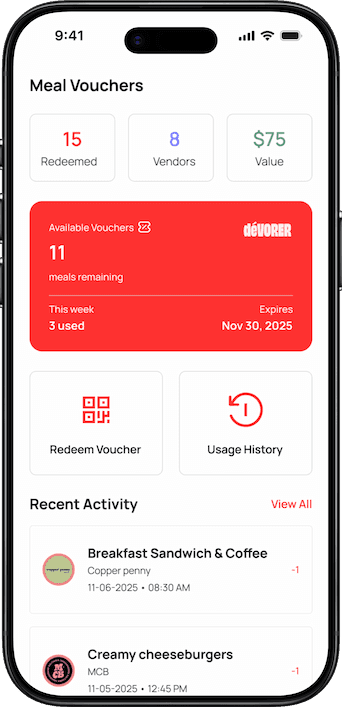
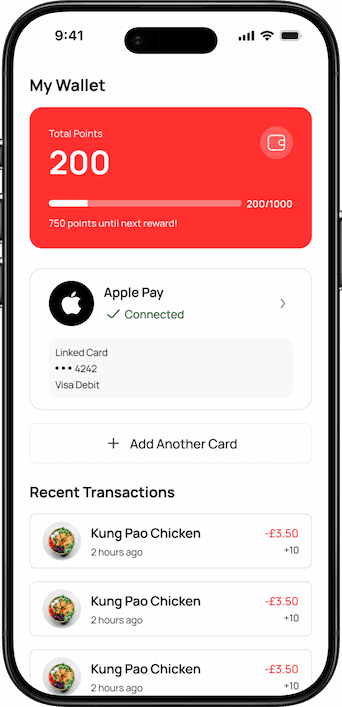
Vouchers, a linked card and loyalty points live in a single mobile-first wallet that works alongside Apple Pay and Google Pay.
Build on what already exists
No direct POS integration. Vouchers are validated through a lightweight scanning interface, and NFC payments run through vendors' existing terminals.
Fast under pressure
Market days are high-volume events. Every flow resolves in a few steps, with outcomes that can be read at a glance.
Three experiences, one system of record.
Dévorer serves three groups with different jobs, contexts and devices. We designed each experience on its own terms, around one shared transaction model, so a meal moves cleanly from a university budget to a student's wallet, across a vendor's counter and into a report.
Access and pay
A wallet for sponsored meals and direct payments.
- Sign in with university credentials
- Open the wallet: vouchers, linked card and loyalty points
- Choose a voucher or NFC payment
- Present a voucher QR code, or tap to pay
- Track history, remaining vouchers and points
Validate and serve
A lightweight tool built for the counter at peak hours.
- Sign in to an authenticated vendor account
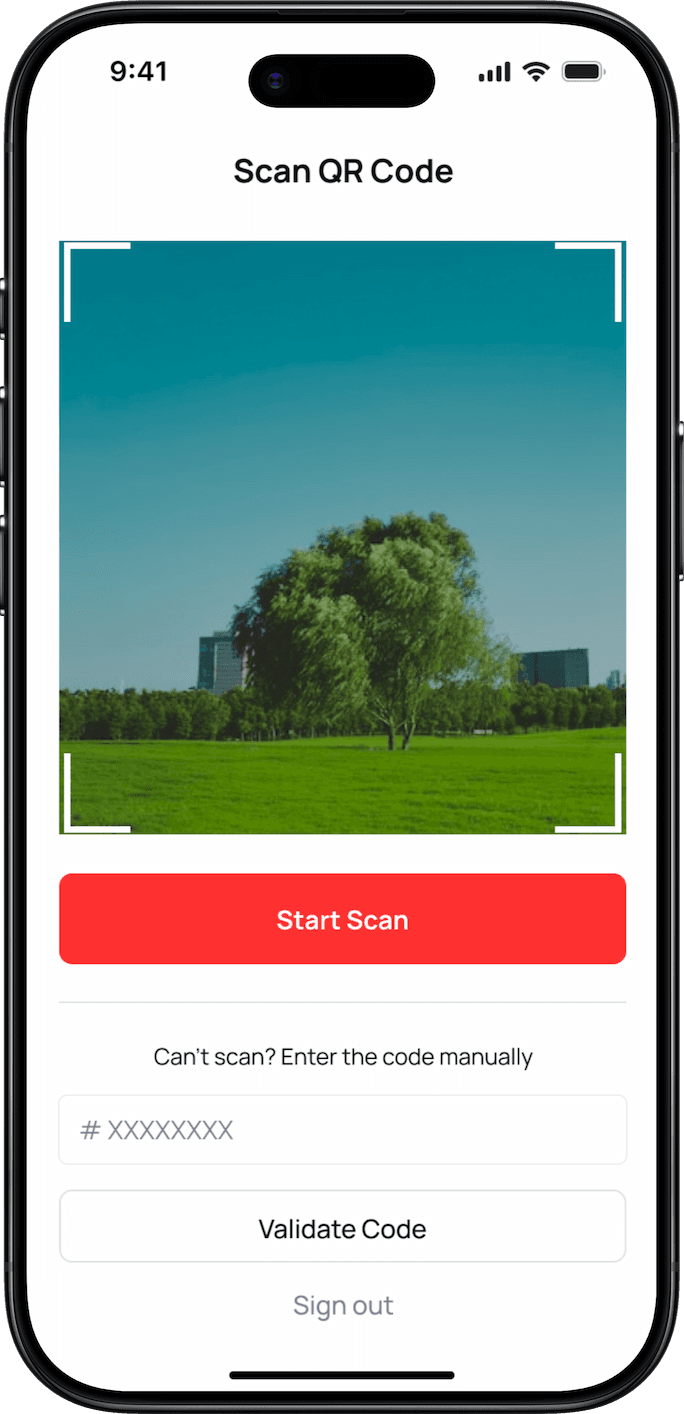
- Scan the student's voucher QR code
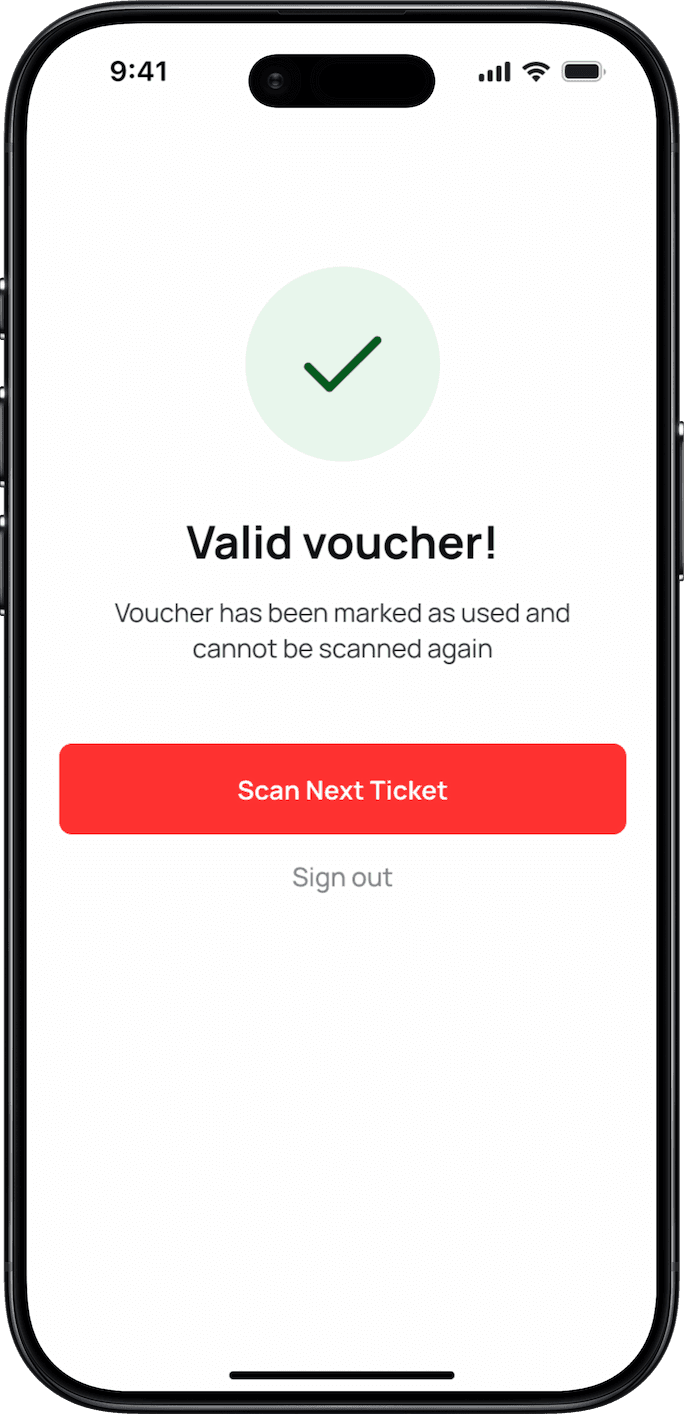
- Get an instant valid or invalid result
- Confirm the redemption
- Records update in real time
Fund and oversee
A dashboard for programme owners and finance teams.
- Create voucher batches
- Distribute them to universities and vendors
- Monitor redemption activity in real time
- Track activity across campuses and vendors
- Export reports for billing and reconciliation
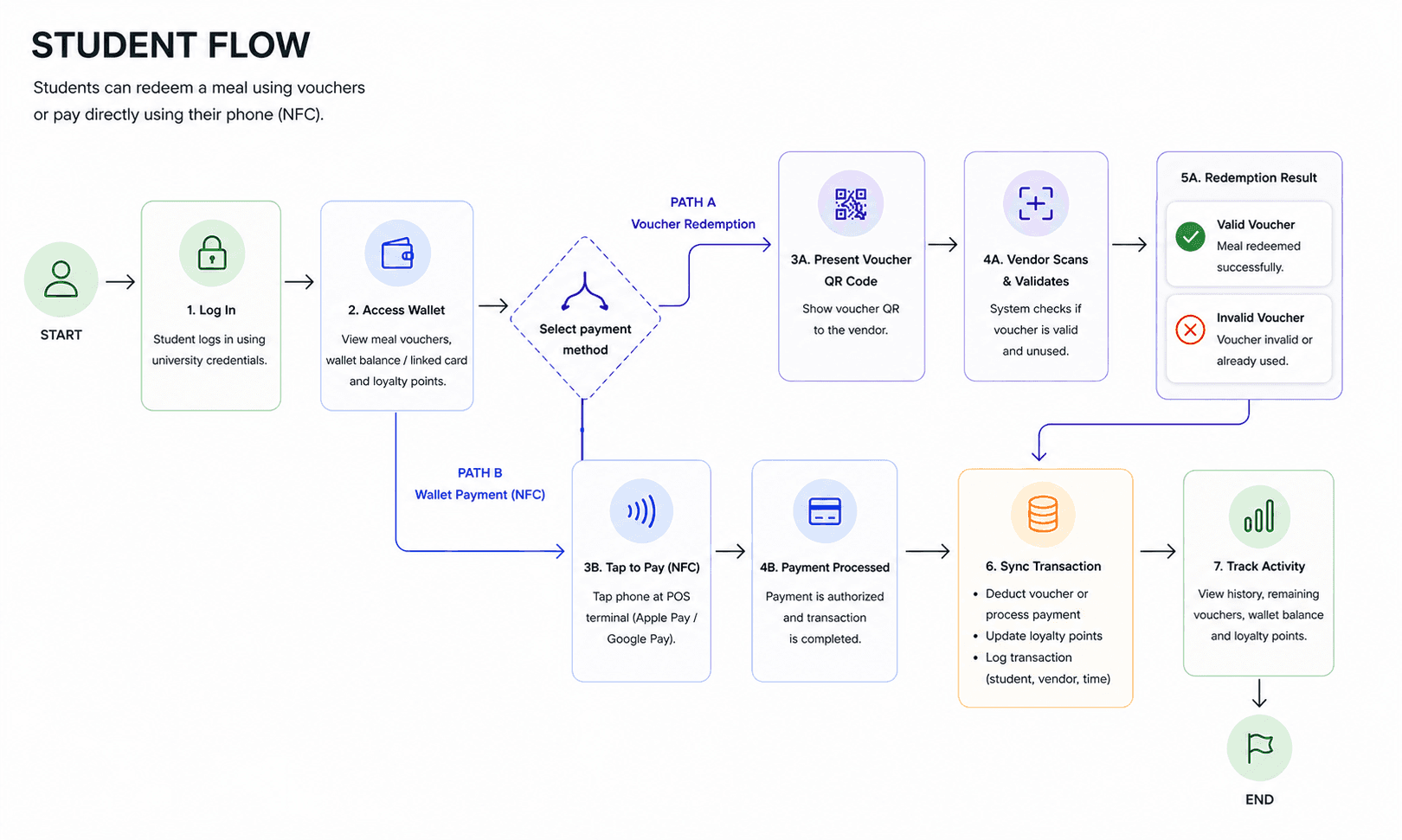
Student flow. Two paths, voucher redemption and NFC wallet payment, converge on one transaction sync that deducts the voucher or payment, updates loyalty points and logs the record.
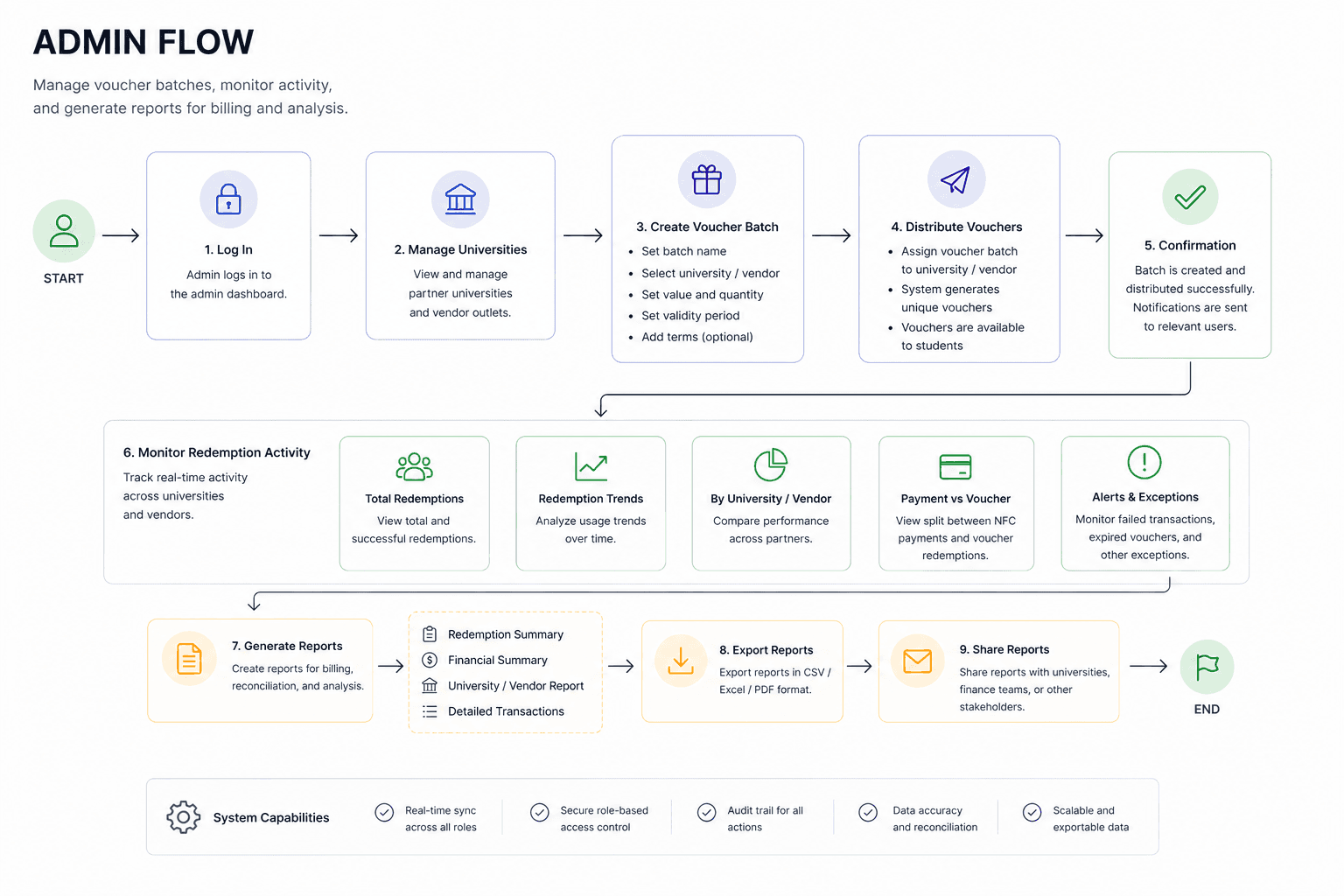
Admin flow. From batch creation and distribution to live monitoring and exportable reports, with role-based access and an audit trail behind every action.
The vendor scans the student. Not the other way round.
The most consequential decision in the product was who holds the scanner. A common pattern has the vendor display a code for customers to scan. We reversed it.
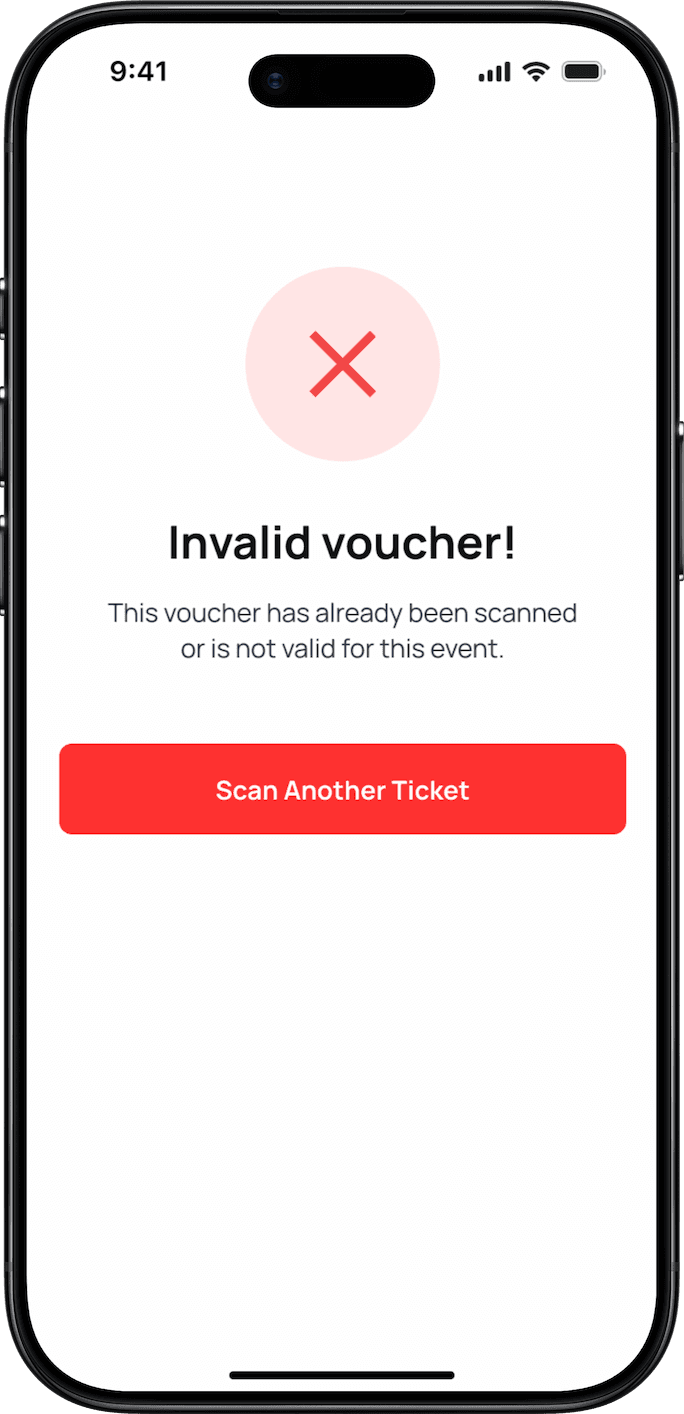
Students present a voucher QR code from their wallet, and vendors scan it from their own authenticated account. The system checks the voucher on the spot and returns one unambiguous answer. A valid voucher is marked as used the moment it is redeemed, so it can never be presented twice.
A small change to the interaction, with large consequences for the business: every redemption becomes a verified, attributable event rather than a claim.
Why this approach
- Fraud prevention. Only authenticated vendors can redeem, so vouchers can't be self-redeemed.
- No duplicate redemption. Vouchers are marked as used instantly, which closes off screenshots and reuse.
- Real-time validation. Vendors know whether to serve before the food leaves the counter.
- Auditable by default. Every redemption is recorded against student, vendor, campus and time.
- Operationally simple. One scan, one clear result. No hardware to buy and nothing to reconcile by hand.
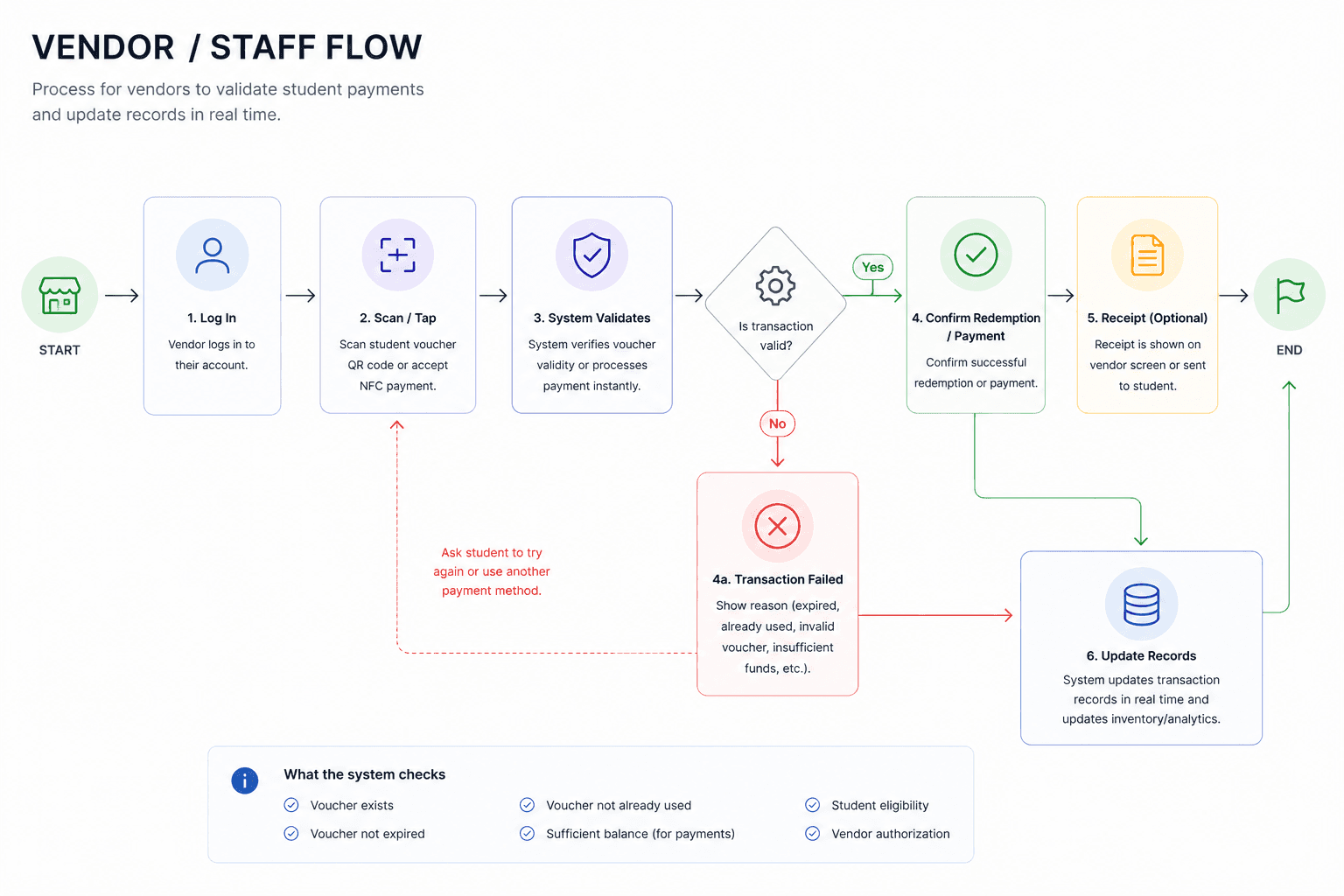
Vendor flow. Every scan or tap passes the same checks before it is confirmed: the voucher exists, hasn't expired or been used, the student is eligible and the vendor is authorised. Failures return a specific reason, so they can be resolved at the counter.
Sponsored meals and direct payment, in one wallet.
Not every student has a voucher for every meal, and a busy market can't wait while someone works out how to pay.
Prepaid meal vouchers sit alongside a linked card that pays through Apple Pay or Google Pay over NFC. Students choose whichever fits the moment, and every transaction, whether funded by the university or paid directly, lands in the same history and earns loyalty points.
- Supports university-funded vouchers and direct payment
- Tap to pay at existing terminals, without navigating the app
- Less friction during high-traffic market events
- Payments, vouchers and points in one place
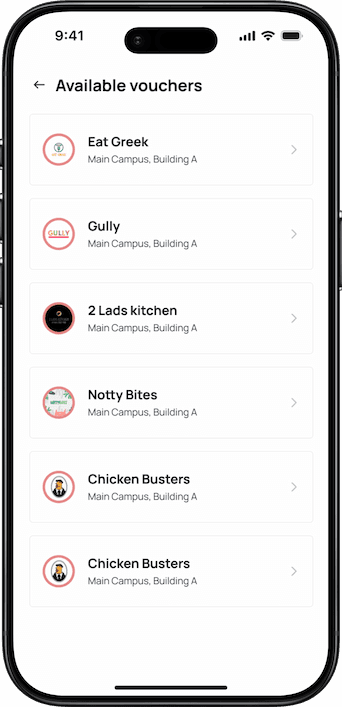
One visual language for every context.
Dévorer spans a student app, a vendor tool used at the counter and an administrative dashboard, across vouchers, card payments and loyalty. The system had to stay consistent across all of them: approachable for students, credible to institutions.
Built to be read at a glance
Status, balance and outcome lead every screen, so scanning and tap-to-pay results are legible in a crowded market.
The fewest possible steps
Voucher redemption and NFC payment are reduced to the minimum, because peak-hour queues magnify every extra tap.
Components shared across surfaces
Cards, transaction rows, status states and inputs are shared between the mobile apps and admin interfaces, keeping behaviour predictable and the build efficient.
One model for every transaction type
Vouchers, card payments and loyalty points follow the same patterns wherever they appear, so moving between them never means learning something new.
The limits that shaped the product.
Dévorer's strongest decisions came directly from its constraints. Each one ruled out an easier answer and pointed to a better one.
No direct POS integration
Voucher validation moved into a lightweight scanning interface on the vendor's own device, while NFC payments run through terminals vendors already use. No new hardware and no integration project.
Existing NFC infrastructure
Direct payment was designed around Apple Pay and Google Pay rather than a proprietary method, so students pay the way they already do.
Multiple universities
Campus-specific targeting, allocation and reporting were part of the model from the start, so each institution manages its own programme within one platform.
High-volume events
Scanning and tap-to-pay flows were kept short, with outcomes that can't be misread while a queue is forming.
Fraud and duplicate redemption
Vendor-side validation and instant redemption locking make every voucher single-use by design.
Real-time tracking
Every transaction syncs across student, vendor and admin views as it happens, giving universities a live basis for billing.
Scalable voucher validation
Working across multiple universities from one platform.
NFC payment support
Built on vendors' existing payment infrastructure.
Real-time transaction tracking
Across students, vendors and campuses.
A foundation for growth
Ready for future web and API expansion.
Dévorer could easily have been scoped as three separate apps. Each would have defined vouchers, payments and records on its own terms, and the gaps between them would have become the places where money leaked and trust broke down.
Designing the rules first, and unifying vouchers, payments and loyalty in one model, means the platform can scale to new campuses without redefining its core logic. It lowers operational risk and makes everyday use simpler at the same time. That is the difference between designing connected product ecosystems and designing isolated screens.
Have something worth
getting right?
Tell us what you're building.